PREAMBLE
The purpose of human rights is, at its most basic level, to ensure a minimum standard of human wellbeing.
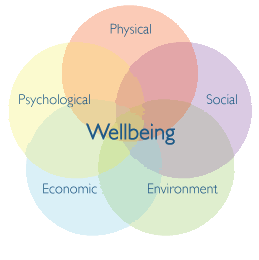
It is proposed that the concepts of ongoing human happiness and human wellbeing be taken as the overarching values from which any instrument of human rights in Australia is derived.
Increasingly, Australians, like other human beings across the planet, have been confronted with the imminent dangers of mistakenly separating human from ecological rights. The effects of climate change, the dwindling access to potable water, and the nutritionally depleted and devastated soils and landscapes, are numerous and widespread.
Inattention to ecological wellbeing inevitably leads to violations of the right to food, right to health (physical, mental, and spiritual), and right to shelter, severely compromising people’s ability to procure the basic means of fulfilling the right to life. Included in such effects on personal wellbeing are the widespread social difficulties associated with food production and farming, that seem to correlate closely to the growing number of mental illnesses and suicides amongst farmers.
As more and larger areas become polluted and unable to sustain food production and access to water, it appears inevitable that people will give up their homes and move to areas where they may be less vulnerable to the effects of ecological degradation and catastrophe.
Existing policies based on "polluter pays” principles are insufficient to address the long-term devastating effects of many industrial practices, including conventional farming methods. The payments are not always directed towards the restoration of the affected environment or for finding and funding alternatives to the practices that create the pollution in the first place. Too often these policies are considered to be satisfactory solutions to the ecological problem, when they should only be seen as temporary solutions until more holistic and ecologically sustainable forms of energy, water supply, or farming are developed.
Unfortunately, where they exist, the human rights regimes of other countries are anthropocentric - only protecting the planet for the purposes of continued resource exploitation. This extends to affording functional (as opposed to theoretical) protection to ecological species, populations and communities once they are extremely endangered.- Australia at least has an advantage in being late to develop a human rights instrument in that it can learn from the weaknesses of existing instruments, overcoming limitations such as anthropocentrism and instrumentalism. Australia is exploring the scope for an instrument to protect human rights at the very point in human history when human society is at an ecological crossroads.
The measures we put in place now to protect Earth and its inhabitants will determine the sustainability of the human race, as well as other species and the environment. We do not have the luxury of engaging in half-measures. A factor which is interwoven with this is the maintenance and improvement of ecological integrity. We do not have the luxury of engaging in half-measures.
Australia is the driest inhabited continent with severely compromised water systems. Australia cannot afford to proclaim any human right that would in any way compromise ecological integrity. Short-term economic benefit; considerations of corporate profit and loss; contractual obligations; or continuation in jobs causing extensive and significant ecological damage cannot take priority over repairing and living sustainably on, from and with the ecosphere.
Australians have the opportunity to demonstrate leadership by framing a modern human rights instrument from a holistic perspective that neither maintains nor continues the errors and misconceptions of past views of humanity’s place in the universe. This opportunity can be fulfilled by acknowledging and enumerating ecologically-centred human rights or well-being. Priorities for consideration include:
- Provision for individuals or groups to bring claims of violations of ecological integrity irrespective of the locality in question. (Humans should be able speak for entities that cannot speak for themselves).
- Investigations of ecological (inclusive of social) impact should not be limited to the immediate vicinity of a project. Scientists and people with traditional or local knowledge should be solicited to ascertain the possible long-term, off-site and not immediately identifiable effects of particular projects.
- Ecological protection cannot be limited to what might be described as ecological excisions or exclusions, e.g. not cutting down particular trees or leaving some portions of a river in their natural state to enable the survival of a particular species. Ecosystems, inclusive of the human component, are inter-connected. Actions in a distant area can have significant impacts on other beings and systems.
- Profit and loss calculations should not be limited to conventional measures of GDP but incorporate the values inherent in natural entities such as river, mountains, and trees, including the value of their role in the various ecological cycles. Practices must be developed which avoid the “playing off” of one resource against another, i.e. mining against water; potable and irrigation water supply schemes against ‘environmental flows’ in streams.
- Australia is already ecologically damaged. There should be a strong political, industry, and social commitment in support of major efforts to restore the health of land and water and the ecological integrity required to maintain a full range of Australian ecosystems and their components.
- It is not enough to enact laws that address human wellbeing more holistically. Consideration must be given to the development of holistic thinking at all levels and across all sections of Australian society. For instance, legal officials, including judges, need to be better educated about ecological issues so that their judgments are not short-sighted or reliant on experts appointed by the proponents and opponents that appear before them. Far greater use should be made of independent expertise (this occurs to a limited extent in the NSW Land & Environment Court, which employs non-legally trained Commissioners in addition to exclusively legally trained Judges, and which can appoint expert advisers to assist the Court / Commission in weighing technical evidence).
Without particular ecological rights, human happiness and human wellbeing are neither well supported nor advanced. We note that the Australian Treasury, which guides this nation’s economic and financial policies, already operates within a WellBeing Framework.
Treasury’s mission is ‘to improve the wellbeing of the Australian people by providing sound and timely advice to the Government, based on objective and thorough analysis of options, and by assisting Treasury Ministers in the administration of their responsibilities and the implementation of Government decisions’.
Increasingly, Western cultures are moving to an understanding that has been integral to indigenous and many Eastern cultures: that we co-exist in a web of life that is, with due care and responsibility, sustainable.
It is proposed that, in the development of a formal instrument to protect human rights in Australia, the Australian Government does so within a Wellbeing Framework. In short, human rights should not be an end in themselves. Human rights should be one of the means by which human happiness and human wellbeing is established in Australia.
The rights proposed should not be seen as the totality of human rights that might be introduced in any future instrument. This proposal has intentionally limited itself to ecological rights and those rights which would enable the free discussion of and activism in support of those rights.